Showing posts with label 6400. Show all posts

Monday, April 29, 2013

6400 Final - Recollection

We are now at the end of the semester.  My final project, which I have decided to call Recollection, is more or less complete.  A few of the items the player can collect are still placeholders.  I plan on replacing them with the final objects in the week or so after finals, at which point I will make the playable game available online.  Until then, there is the above video which is the deliverable for the class.  


This project began with Neil Gaiman's poem which outlines what to do if one finds oneself in a fairy tale.  I was particularly interested in the end, when the fairy tale is over, and the hero(ine) returns home to find it is now smaller somehow.  I decided to set my game in the backyard of my childhood home.  The story is based off my own memories of walking through a gap in the hedge behind my neighbor's house to get to my friend's backyard.  Along the way, the player find various objects that I remember owning; things that were important to my child-self.  With each object, the player's view changes.  When the player returns home, they will find it seems much smaller.

Other games that have provided inspiration for me include Antichamber, Gone Home, and oddly enough Assassin's Creed.  Antichamber is an excellent example of using a simplified visual style, and creating unreal spaces as a metaphor for life and thought.  Although not yet released, Gone Home is shifting the focus in first person games away from combat and towards exploration.  The story in Gone Home is told entirely through the artifacts left in the virtual space.  The player must sift through those artifacts and piece the story together themselves.  As I worked on Recollection, the game became more and more about my own process of reconstructing memories.  Although it is not all that obvious, Assassin's Creed is, in many ways, about reconstructing memories (in this case, ancestral memories).  I was particularly interested in the memory walls which cut the player off from parts of the game world.  This was one of the influences on how I chose to deal with the edges of the world in Recollection.

I hope that when I finally post the game online some of you will play it.  It is frustrating to be only able to show the documentation.  Videogames cannot be reduced to cinematic shots without a great deal of loss.

Sunday, April 21, 2013

When you're born in the Bayou...


I was initially interested in 1927's The Animals and Children took to the Streets because the animated portions have a visual style that is similar to Machinarium.  The environments are all rendered with shaky line-work, muted colors that almost look like stains, and beautifully incorrect perspective.  So, when two of my professors, and my dad and step-mom recommended I go see this play, I figured I probably should take the time to do so.  I was most certainly not disappointed.

The Animals and Children took to the Streets uses a mix of live theatrical performances and projected animation.  Mixing live theater performances with animation is not a new idea.  It is in fact a very old idea.  Many of the early animators were popular Vaudeville performers, and it was not unusual for them to include their animations with their acts.  Winsor McKay's early animation Gertie the Dinosaur was specifically animated to be part of a theatrical performance.  From what I understand, stand alone animations won out as Vaudeville began to disappear and animators realized it was more financially sound to make a film they could copy and sell rather than to do repeated live performances.  The use of projection and animation is of course, much more sophisticated now.  The mixture of performance and animation had the interesting effect of making the play seem to be somewhere between theater and narrative dance.  The actor's movements needed to be precisely timed in order to match up with the animated projections; thus the movements became dance-like.

The Animals and Children took to the Streets focuses on poverty and the systemic structures that prevent people from improving their lot in life.  The children who terrify the adults are reacting to legitimate injustices. The children know there is something wrong with their living situation, but they don't fully understand what it is or why it is.  So they do the only thing they can think of to do; they act out aggressively.  The adults in the slum known as the Bayou understand the problems that keep them in their miserable conditions, but they also understand their own powerlessness.  Agnes Eaves is the one exception.  She naively thinks that she can change the Bayou for the better, but she is not from there and does not truly understand the problems and doesn't have the power to facilitate improvement.  The Mayor arguably does have the power needed to help the people of the Bayou.  However from his point of view, the only real problem is that the children in the Bayou have yet to learn their place.  The problem with the society in The Animals and Children took to the Streets is that the people who have the power to create positive change don't care to do so, and those who do care, lack the ability to cause change. 

Near the ending of the play, the lone male protagonist stands at a cross roads.  To one side is an idealistic ending, and the other is a realistic ending.  Audience participation is called for as the protagonist contemplates his paths.  In the performance I attended, the audience cheered most loudly for the idealistic ending, but the actor took a perfect 'why bother' posture just before walking down the idealistic path then ran down the realistic path.  I suspect there is only one ending to the play.  The moment is about asking the audience to consider what they want and expect out of the story rather than actually offering a choice to the audience. 

I mentioned at the beginning of this post that the visual style of The Animals and Children Took to the Streets reminded me of the game Machinarium.  It may seem surprising, but the stories are actually quite thematically similar as well.  The main character in Machinarium is so far down on the social ladder that he is literally treated like trash (and I do mean literally - the game starts with him being thrown in the town dump).  The game itself is a find-the-object puzzle game.  The player spend the entire game scrounging around for any discarded object that can help the protagonist get the better of the three bullies who personify the social forces keeping him powerless.  However the endings differ between Machinarium and The Animals and Children Took to the Streets. Machinarium has a happy and unsatisfying ending.  It feels as though Amanita Design didn't really know how to end the game, and as a result the ending was unrealistic.  As much as I may have preferred an idealistic ending in The Animals and Children Took to the Streets, the realistic ending was obviously, and unfortunately, more realistic.

Monday, April 8, 2013

Jobs and Opportunities

Many of the opportunities for conferences/festivals center around the Game Developer's Conference (GDC), which takes place in March.  Since we are supposed to focus on up-coming opportunities for this assignment,  there are a limited number of game-related conferences I can write about.  However there are a few such as the following:

IndieCade - an "International Festival of Independent Games" IndieCade takes place in early October.  The deadline for the call for submissions is May 31st.  In addition to the showcased games, IndieCade features workshops, master classes, keynotes and more.

TWO5SIX - gaming culture group Kill Screen has recently organized their first conference.  The one-day conference is "devoted to the spaces between games, play, interaction and creativity."  Although it is not always convenient to make a trip down to New York for one day, a live stream of the conference is available to people who purchase a livestream ticket.


Twofivesix: A Videogame Arts + Culture Conference from Kill Screen on Vimeo.

As for distribution of my work, the obvious answer is the internet.  It is fairly easy to get short-form games out into the world.  The ideal situation for someone to play a videogame is on their home computer, which makes online distribution perfect, particularly if the designer is not all that concerned with earning money.  Steam Greenlight makes the steam online distribution platform more available to independent developers, although it seems to mainly be appropriate for fairly well-established designers with a motivated fan-base.  iOS and Android market places offer another avenue for game designers, although designers will need to be able to navigate the approval processes and the curation of mobile markets does limit the issues a game can address on mobile platforms.

Tuesday, March 26, 2013

Teri Rueb - Artist Visit


Teri Rueb gave a presentation here at ACCAD last week.  Rueb creates interactive soundscapes using GPS headsets.  In her work the landscape becomes the interface for the interactivity.

In order to experience Rueb's work, participants must visit particular sites, and wander while wearing headphones.  While wandering, the participant will encounter a sound zone.  In Drift, the sounds played are randomly generated and the triggering zones drift in and out with the tides along the site.

During the talk something about the role of the headphones bothered me.  Wearing headphones in public is a common occurrence these days, however it is typically a way for people to cut themselves off from their surroundings, particularly the surrounding people.  Rueb's work seems to be about trying to heighten the experience of place and culture, but it is doing so by using technology which cuts the individual off from their surroundings.  Perhaps for this reason I felt Rueb's Elsewhere : Anderswo was the most interesting.  Because the piece itself is about alienation, the meaning of wearing headphones in public does not conflict with the meaning of the work.

Rueb's work and the technology used have evolved together over the years.  In earlier projects, Rueb had control over the hardware (GPS/computer and headphones), but as GPS devices have become more ubiquitous, the work has shifted to apps which participants can download and use with their own various devices.  This shift has meant Rueb faces a loss of control over how participants experience her work.  She expressed ambivalence regarding how participants interact with apps as opposed to the earlier devices.  She was particularly concerned about participant's fickle attentions when using an app on a multi-function device.

In game design we have an idea called the magic circle, which denotes the in-game world as distinct from the rest of the world.  The magic circle is more of a mindset than an actual space.  It can be identified in aspects of life other than games, particularly within rituals.  When Rueb talked about the mindset she wants to inspire in her participants, I believe she was referring to a form of the magic circle.  While it's true that taking phone calls and such does mean leaving the magic circle, people tend to leave and re-enter the magic circle easily.  I can't help but to think of how easily players move between in-character and out-of-character dialogue when playing games like Dungeons and Dragons.

One of the problems with discussing Rueb's work here, is that I have no first-hand experience with it.  In her talk, she was somewhat apologetic that we could only see her documentation and not experience the work itself.  This is a problem that I have been struggling with quite a lot lately.  The documentation of an interactive work is always a pale shadow of the work itself, and yet we often need to advocate for our work with only the documentation.  In the videogame community a system has been worked out where designers release a trailer to get people interested, then a free demo to allow them to experience a bit of the game without too much commitment, and that will hopefully allow your audience to find your game.  This, however, does not necessarily work well with the academic structure.  Unfortunately, the more typical method of documentation for installations doesn't particularly make sense for documenting videogames.

Sunday, March 24, 2013

Columbus Moving Image Art Review

On Friday I attended the 14th Columbus Moving Image Art Review. The review showcases moving image works created by local filmmakers. The works ranged from abstract to narrative. The artists and work were as follows:

Matt Swift -- City Lights 

Lindsay LaPointe -- Rainboxes 
Vita Berezina-Blackburn -- Walker in the Field 
Nikki Swift -- City Walks -- 22 -- Boston 
Sean McHenry -- My Quiet Day 
Eric Homan -- Life-Lapse 2013 
Kevin Harkness -- Self Portrait Liz Roberts -- Flesh Suitcase 
Shannon McLoon - Bodyscape 
Franz Ross & Chris Wittum -- Spaceman 
Eric Hanson -- Writer & Red 
Andrew Ina -- Pastime 

The first two pieces featured hypnotic visuals set to music. City Lights wove together abstracted footage of the city to create patterns of light. Rainboxes explored the rhythm of falling rain.


Vita Berezina-Blackburn's piece, Walker in the Field, was especially interesting to me because I am currently taking a motion capture class taught by the artist.  Walker in the Field shows a ghostly figure walking among plant-like forms that represent places the walker has been and will be.  It is an interesting and thoughtful visualization of how the body moves through space.  

Several of the short pieces explored the rhythms and beauty in mundane life.  Life-Lapse 2013 by Eric Homan (who, incidentally, was my first 3D animation teacher) consists of time-lapse footage of every-day scenes from his life, including domestic scenes and his working life as a filmmaker and a teacher.  By compressing the day to day experience of life into a few minutes, we are invited to contemplate the actions we take over and over again in our own lives.  

Flesh Suitcase and Bodyscape were both meditations on the human body as object.  Flesh Suitcase offered many uncomfortable images.  As a vegetarian, I found the ending scene, which focused on human feet stepping on raw ground meat, to be particularly disquieting.  Bodyscape took a more glorifying stance to the human body.  This imagery in this film depicted the human body as an object for aesthetic contemplation.

Eric Hanson's Writer & Red explored the creative impulses that drive storytellers and the distractions which hinder them.  The Writer finds himself haunted by a story character he has created in his mind, but has not given form to in his writing.  Although the Writer is working towards his goal of being a creator, he has allowed the work he feels he should be doing to distract him from the work he wants to be doing.  The story is about the Writer reconnecting with his original reasons for being a writer and beginning the work he truly believes in.  

Wednesday, March 6, 2013

Tale Type 510A


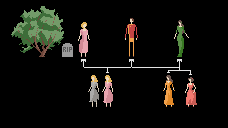
The title of my animation refers to the Aarne-Thompson-Uther folktale type associated with Cinderella.  Some of the dialogue is quoted from D.L. Ashliman's translation of the Cinderella variation collected by the brothers Grimm.  Much of my retelling of Cinderella is based on the German version.  This means that my audience may be unfamiliar with some aspects of the story due to the fact that most American audiences are more familiar with Charles Perrault's French variation and Cinderella stories based off that version.  In the battle sequence, I reference the French version by showing two possible summons Cinderella can use, the pigeons and the more familiar Fairy-Godmother.  However, the Fairy-Godmother is grayed out, and a negative sound plays to show the "player" is trying to select it but cannot.  Including the grayed out Fairy-Godmother option serves as a nod to both the multiple variations of folktales and the potential for variations in a single videogame narrative.

In my animation I make many references to videogames from the 1990s.  The character name screen is modeled off of the Final Fantasy games, and most of the third person scenes are referencing the Final Fantasy games, Dragon Warrior, and The Legend of Zelda.  Even the odd text break in the step-mother's dialogue is an intentional nod to 1990s videogames which were often translated from Japanese to English by people who were either not paying attention to text breaks or could do nothing about awkward text breaks due to technical limitations.  The lentil sorting scene is designed to directly reference the battle sequences in Dragon Warrior.  I am interested in how game mechanics can mapped to unusual meanings, and here I have mapped the heavily text based battle mechanics from Dragon Warrior onto a dull domestic task from the Cinderella story.

The design of my characters has a decidedly more contemporary influence.  The character style is inspired by the 8-bit work of the artist known as Superbrothers.  While I was contemplating the use of gradients in Superbrothers: Sword and Sworcery EP to denote the supernatural, I decided to break the illusion of a true 8-bit game by depicting Cinderella's mother as ghost which fades smoothly into and out of existence (an impossibility with 1990s videogame technology).

The style of the simulated gameplay changes for the ball sequence.  At this point the "game" becomes a side-scroller with a timer which counts up to Midnight.  With this re-imagining, the prince becomes an obstacle for the imagined player.  The prince slows the player down thus potentially causing her to run out of time.  In this animation, the imagined player also makes the mistake of picking up the dropped shoe, which disrupts the typical Cinderella narrative.  One of the issues we frequently confront when dealing with narrative in videogames is the problem of what to do when the player does something that ruins the sequence of events in the story.  One option is to simply give the player a game over screen and make them try again, which is the point at which I end this animation.  Careful viewers may notice that the cursor in the game over screen lingers on quit before going back to save and quit.  I wanted that action to show that the imagined player is considering leaving the game and never coming back (which would make saving the game unimportant), but ultimately decides that she will return to the saved game.  Although the animation does not end well for Cinderella, the actions on the menu screen indicate that the player intends return and bring about the happily ever after we all expect.

For the music I used three songs off of the 8-bit album Risistor Anthems created by Eric Skiff.  The album has been released under the creative commons attribution license.  The three songs are Digital Native, Arpanauts, and Come and Find Me.  I generated the sound effects using as3sfxr, an online 8-bit and 16-bit sound generator.

Monday, February 25, 2013

Project 2 Proposal

For my second project in this class, I propose to create an interactive piece.  This will be a videogame focused on giving the player a sense of exploration and of leaving the ordinary.


In my post about Superbrother's Sword and Sworcery EP, I talked about the idea of center/periphery in Legends.  One of the reasons I am fascinated by this idea is that the center/periphery structure is similar to the structure of certain types of games, specifically 3rd Person Adventure games (i.e. The Legend of Zelda) and Role Playing games (i.e. the Final Fantasy games).  Quite often these games begin the main character's home, and frequently in the character's bedroom.  Some event or another prompts the character to leave home and venture in to the world.  The farther from home the main character travels, the more he or she encounters strange and dangerous creatures.  At the end of the game the main character usually returns home and resolve whatever prompted his or her journey.  I would like to explore this journey into the unfamiliar in videogames.

I found inspiration for this project from Neil Gaiman's poem Instructions.  The poem lays out what to do if you find yourself in a fairy tale.  It mentions several ways to travel away from the familiar world to another world, and in the end, you can return home only to find it has changed.  I plan on setting my project in a space that is familiar to me: the backyard in my childhood home.  My backyard had a pathway through some overgrowth.  There was just enough room for a child to climb under it, and it lead to my friend's house.  Our parents did not like us to go through this path, in large part because it meant cutting through a neighbor's garden.  But we did travel through it quite often, and it always felt like a daring journey.  In my videogame I would like this path to lead to a strange place with its own odd rules.


I am also inspired by the First Person Puzzle game Antichamber.  This game similarly has a safe beginning space, from which the player ventures into a bizarre world governed by unique logic.  Throughout the game the player frequently returns to the beginning space, which is changed slightly by what the player uncovered in the main part of the game.

Sunday, January 27, 2013

Pixel Art & Animatic


I've begun creating the pixel sprites for the animation, and reading about <a href="http://www.squidoo.com/how-to-make-8-bit-music">chiptune (8-bit) music</a>.  I'm not terribly musically inclined, so I'm not sure if I'm going to make music for the film or just use sound effects.  Either way I would like to create some custom audio.

For the pixel art I'm focusing on getting the major character sprites and basic outlines for the backgrounds.  I'm not sure at this point if any of the scenes are going to fully animate.  Although I've created pixel art before, I don't have a lot of experience with pixel animations.  Creating the actual animations could easily become very time consuming.  For most of the scenes limited animation will be appropriate, however the fireplace scene and a few others would be more interesting with full animation.  I have put together a preliminary animatic; currently it has no sound.


I've been debating how to deal with moving sprites around the scene.  AfterEffects does sliding animation well, however the sprites move in smaller increments than the enlarged pixels.  This results in an inconsistency in the pixel art style.  This inconsistency doesn't necessarily bother me, however an appropriated balance will need to be struck between the limitations of traditional pixel art and the freedoms of modern high resolution imagery.  Superbrothers Sword & Sworcery EP strikes a similar balance by combining pixel art with smooth gradients.

Sunday, January 13, 2013

Project 1 Proposal

Concept:
Tale type 510a - Cinderella told through motion graphics.

Narrative Arc:
Although the details of the story of Cinderella vary, each version is recognizable as the same story.  Below is a quote detailing the plot that Cinderella stories share, with some notes on places were variation exists:
"A young woman is mistreated by her stepmother and stepsisters, forced to work as their servant, and usually called by a name associated with ashes or dirty labor. When the stepsisters and the stepmother are invited to a ball (or leave to attend church), they assign an impossible task to Cinderella to prevent her attendance. Usually animals complete the task for her while she receives beautiful clothes from a fairy godmother or other magical helper. She attends the ball (or church) incognito where the prince falls in love with her. She must leave early before her magical accoutrements disappear or her identity is discovered. The same occurs a second and third time with Cinderella losing a shoe as she runs away the third night. The prince acquires the shoe and declares he will wed the woman it fits. Everyone unsuccessfully tries the shoe, including the stepsisters who mangle their feet trying to make it fit, until Cinderella is finally discovered and compelled to try on the shoe. When it fits, she and the prince are married." - SurLaLune Fairy Tales: History of Cinderella
In a talk on the shape of stories, Kurt Vonnegut graphed out the basic Cinderella story, shown below:
The shape of the Cinderella Story - adapted from Kurt Vonnegut's "The Shape of Stories" talk.
The narrative arc I am proposing will stay fairly close to the German variation on Cinderella.  The story will begin with introducing Cinderella's family situation, the middle will consist of her visit to the ball, and the story will climax with the search for the woman who fits the shoe.

Technique:
The animation will be created in a pixel style.  Pixel style graphics are associated with the early days of computer and video games when the technology could only support extremely low resolution images.  Although the technological limitation has been lifted, pixel styles persist in part due to the nostalgic appeal of pixelated images.  Because contemporary pixel artists do not have the same technical limits as they did in the past, pixel art has changed, and can be combined with other styles as in Superbrothers' Sword and Sworcery EP.

Part of the appeal of fairy tales is also based in nostalgia.  However, when a fairy tale is re-told it is inevitably changed to appeal to contemporary audiences.  The story may be based in the past, but it is also of the present day.  This dual existence is mirrored by the pixel technique which is based in the past, and important to present.

Sketches/Images:


Storyboard:


Model for this project:  

DOT MATRIX REVOLUTION from superbrothers on Vimeo.

I've also been looking at Lotte Reiniger's Cinderella, although it is not particularly informing the style of the project I am proposing.

Timetable:
Week 1:
  • Animatic 
  • First draft of sound 
  • Begin creating sprites
Week 2:
  • Create essential sprites and simplified backgrounds
Week 3:
  • 2nd draft animatic using sprites and simplified backgrounds 
  • Identify if any additional sprites or backgrounds are needed
Week 4:
  • Finalize sound
  • Created any additionally needed sprite animations
Week 5:
  • Complete final animation using final sprites/backgrounds

Distribution or Exhibition:
The internet/Vimeo
Ohio Shorts Festival